Musings from Arledge: Is Lincoln Riley Dante Bichette?
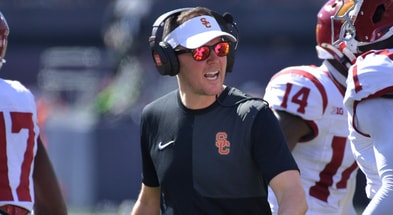
Jen Cohen is gambling that Lincoln Riley is Dante Bichette. We should know twelve months from now whether she is right.
Real estate agents tell you that it’s all about location, location, location, and it turns out this is sometimes true in the sports world as well. As most of you probably know, Bichette was a successful MLB slugger in the 1990’s, primarily while playing for the Colorado Rockies. In 1995, Dante Bichette finished second in the National League MVP voting, hitting .340 with 40 home runs. But those numbers were highly dependent on his location. In the light air of Coors Field, Bichette hit .377 with 31 home runs. On the road he hit .300 with nine home runs. Those road numbers are solid; they are not MVP numbers. Bichette was great because he played in the best possible situation. Anywhere else, he was good but not great.
Four years ago, Lincoln Riley was the hottest coaching prospect in college football. LSU made a run at him before USC landed him. He was seen as a sure-fire success, a guy who would offense his way to 10 or more wins every year and, if he could just figure out that defense thing as he got more experienced, he was seen as a guy who could build a dynasty.
Lincoln certainly bought the hype. He told the world that USC was going to be the Mecca of college football and he talked about getting USC back to where it belongs. I think he still buys it. Just recently he was assuring the world that he knows what it looks like to have a championship level squad. (The cynic in me wants to know how he knows what it looks like being that he never won any championships. Does he know how it looks because he watched reruns of the SEC Network to see what Nick Saban and Kirby Smart were up to all those years?)
It’s clear by now that some of that hype was unjustified. Lincoln Riley is not a miracle worker. He’s not a guy who can build something where it’s impossible to build. That’s not a shot; few guys can. There are only so many Bill Snyders who can build a top-10 program in the wasteland that was Kansas State or Curt Cignettis who can build a championship-level program in Indiana. Four years in, we know Lincoln Riley isn’t one of those guys. He’s not a magician.
We also know he did not have the support he needed for the first few years of his tenure. His situation at USC was dramatically different than his situation at OU. What Lincoln Riley inherited in Norman was pretty great. OU wasn’t the best program in the country, but it was likely a top-five program. OU had a significant advantage over its Big 12 opponents other than Texas. Only OU and Texas had the institutional support and tradition that allowed for sustained success. Both programs had a huge recruiting and talent advantage over everybody else in the conference. And Lincoln Riley inherited Bob Stoops’ program culture. When Stoops took over at Oklahoma, the program was a disaster. But he very quickly rebuilt the program, won a national title, and maintained a high-level program for many years. The culture in Norman was a winning culture, and it was Bob Stoops’ culture.
We know that having inherited everything that Bob Stoops and his predecessors had created at OU, Lincoln Riley was pretty good. He certainly scored a lot of points and had unsurpassed quarterback success. He won a lot of games, though he was never able to compete with the elite programs on the biggest stage.
So Lincoln is not a miracle worker. The question is whether he’s Dante Bichette. If you give Lincoln Riley the best possible situation, can he bring home a championship?
This is exactly what Jen Cohen has set out to do. She helped fix USC’s NIL situation. She is giving Lincoln Riley an elite football facility. She has bankrolled his assistant coach hires. She has surrounded him with an elite administrative staff with Chad Bowden and his team.
And she is being patient.
I think this explains USC’s recruiting strategy.
USC is picking up experienced pieces in the transfer portal. But it isn’t overpaying for the elite transfer portal guys. USC built an elite class of high school recruits, and if you look at the last two classes—and the one USC seems on the verge of building for the 2027 class—you’re talking about a group that will have the talent to compete with anybody, including Georgia, Ohio State, and Oregon in the coming years. That takes time. It also costs a lot of money.
Still, it costs less money than building a program the way Texas Tech has. Dipping into the portal for practically an entire starting offense and defense by outbidding everybody for the top stars is extraordinarily expensive and really only a viable strategy if you have a billionaire backer who is single-minded in his determination. You need a Cody Campbell or a Phil Knight.
USC doesn’t have a sponsor like that right now. And it’s not clear they’d want one. There is a huge downside to essentially selling your athletic program to one rich outsider. Campbell and Knight own those programs and, in some respects, own those universities. And if you read the article about how Phil Knight exerted his influence at the University of Oregon, you might be hesitant to sell your university to a billionaire.
So what’s the strategy? Build an elite roster from the high school ranks over multiple years. Let that group develop and build cohesion. And while you will undoubtedly lose some of those guys in the transfer portal, if you do your job right by handling the financial and relationship side, you’ll keep the guys you care most about.
We know that Cohen and Bowden did not expect to turn around the program immediately. One of USC’s elite recruits quoted Bowden as saying that USC would be a solid 8-4 or 9-3 team in 2025 and would compete for a championship in 2026 or 2027. Some of these elite guys will play immediately. Luke Wafle, Jamieon Winfield, and Mark Bowman will be in the rotation from day one. I suspect all three will be very good in year one. Others will, too. But when you land a high school class, you expect that most of that class won’t be ready to contribute at an elite level for two to three years.
If you project two years down the road, you’re looking at a defensive line with guys like Jahkeem Stewart, Floyd Boucard, Luke Wafle, and Jamieon Winfield, an offensive line with guys like Keenyi Pepe, Breck Kolojay, Hayden Treter, Elijah Vaikona, and Aaron Dunn, a secondary with Elbert Hill and R.J. Sermons, and a receiving corps with Trent Mosley, Mark Bowman, and Boobie Feaster. There are plenty of others I could have mentioned, and this list doesn’t include the 2027 class, which is likely to be stellar.
- 1
 New
NewGreg Sankey denies super league talks with Big Ten
- 2

Update on NCAA's age-based eligibility proposal
- 3

Tennessee intel: The latest on the Chaz Coleman situation
- 4

Could the Big Ten or SEC break away from the NCAA?
- 5

Tennessee hires new pitching coach
Get the On3 Top 10 Newsletter in your inbox every morning
By clicking "Subscribe to Newsletter", I agree to On3's Privacy Notice, Terms, and use of my personal information described therein.
So if you’re playing the long game, what do you grab from the portal right now? You can’t really expect to win a title in 2026. The schedule is brutal, and the guys you’ve targeted from the high school ranks, while extremely talented, are too young. So what you need are culture-building guys.
Let’s be honest about something: the culture on that 2025 team was defective. The guys didn’t quit—that’s a big mark in their favor—but they also didn’t play hard much of the time (especially in the defensive front seven) and they didn’t play disciplined or fundamentally sound. I blame the coaching staff for a lot of that, but I also blame the players. Keeshawn Silver got a ton of money out of the portal to control the A gap. His unwillingness to play low and play hard was unacceptable. And he’s not alone.
So you find veteran guys in the portal who you think will provide leadership, guys who will play hard and play fundamentally sound. You pick up Gavin Meyer types. They don’t cost you a lot of money, and they’ll play hard and do what they’re supposed to do. They’ll provide leadership for the younger, more talented guys in their position groups. They’ll help you avoid the constant breakdowns that come with guys, say, refusing to set the edge or play low against double teams.
Because the one thing you should fear if you’re Jen Cohen is that you give Lincoln Riley everything a coach needs to be successful but the project fails because Lincoln Riley is unable to build a winning culture. And so far he hasn’t done it. The lack of an NIL program for the first few years meant that Lincoln Riley could not build an elite roster by January of 2026. But lack of NIL didn’t stop him from building a winning culture. You don’t need money for that. That’s on him. And so far he’s failed.
Lincoln Riley believed that his time at OU showed him what it takes to build a championship contender, and he was convinced he could do the same at USC. USC believed him and gave him an enormous long-term contract. But Riley didn’t build anything at OU; somebody else did. And seeing how somebody else built a program might help prepare you—it certainly benefitted Lane Kiffin and the many other branches of the Nick Saban coaching tree—but it does not necessarily mean you can build one yourself. So the question remains whether Lincoln Riley is Dante Bichette—good enough that if you stick him in the perfect position he’ll have success but anywhere else he’s just a little better than average. USC is hoping he is, and they’re hoping he strikes gold in 2027.
I think 2027 is also when Lincoln Riley will finally hire a defensive coordinator. So everything should come together at just the right time.
Understand that while Curt Cignetti did the impossible at Indiana, he did it with experienced players. Indiana is one of the most experienced teams in the country this year, and they were last year, too. That’s how Jim Harbaugh won his national title at Michigan as well. This Indiana team and that Michigan team were full of fourth and fifth-year players. Teams with that much experience tend to play hard and smart. Unless USC is going to dip into the transfer portal and land Cody Campbell, their best play is to build with the high school ranks, let those talented players start to get some experience, and supplement the roster with experienced vets who will help build the culture. It’s the right play.
Some years ago many of us wondered whether USC even cared about football success. We know now that this administration does. USC’s athletic department today is run by committed pros. They’re smart and they’re focused, and they’re gambling on Lincoln Riley, a guy they inherited.
And while I think they’re pointing towards 2027 as the real window for winning a national title, we’ll know before then whether the gamble is paying off. Lincoln Riley’s program has to take major steps in the culture department. He needs a team that plays hard in the first half and doesn’t cruise for the first 30 minutes like the team did most of this past year. He needs a team that plays fundamentally sound and doesn’t consistently make the same foolish mistakes that would be unacceptable on a high school team—like they did so often in 2025. We’ll know this coming year whether the plan for 2027 is going to work. If we see undisciplined, uninspired nonsense from the 2026 team, then we’ll know Lincoln Riley isn’t Dante Bichette after all. We’ll know that he simply doesn’t have what it takes to build a program, and because USC can’t hire Bob Stoops to build a winning culture for him, it will be time to cut our losses.
USC is betting on Lincoln Riley and giving him the tools to succeed. I hope they’re right about him. If not, we’ll know more in about twelve months, and a new coaching search—much more exciting than Defensive Coordinator Watch 2026—will be on. I really don’t want to see that.